

Jump to a sectionFamily memories, neighborhood history, food and a thoughtful visit
Before Chinatown was a place I wanted to write about, it was somewhere my mom took us on the weekend. We’d shop for groceries, pick up snacks and get something to eat. Those trips were a reward, but they were also part of how our family stayed connected to where we came from.
I’m Chinese-American, with a Fuzhounese and Hong Kong family background. My childhood memories include both Philadelphia’s Chinatown and Manhattan’s Chinatown, following my mother with my younger brother, often with other relatives beside us. The memories overlap. The neighborhoods have their own histories.
The weekend ritual I remember
My mom raised us as a single mother. She worked hard, and a Chinatown trip could turn an ordinary weekend into something we looked forward to. It didn’t have to be a big outing. Groceries, a bakery stop and a bite to eat were enough.
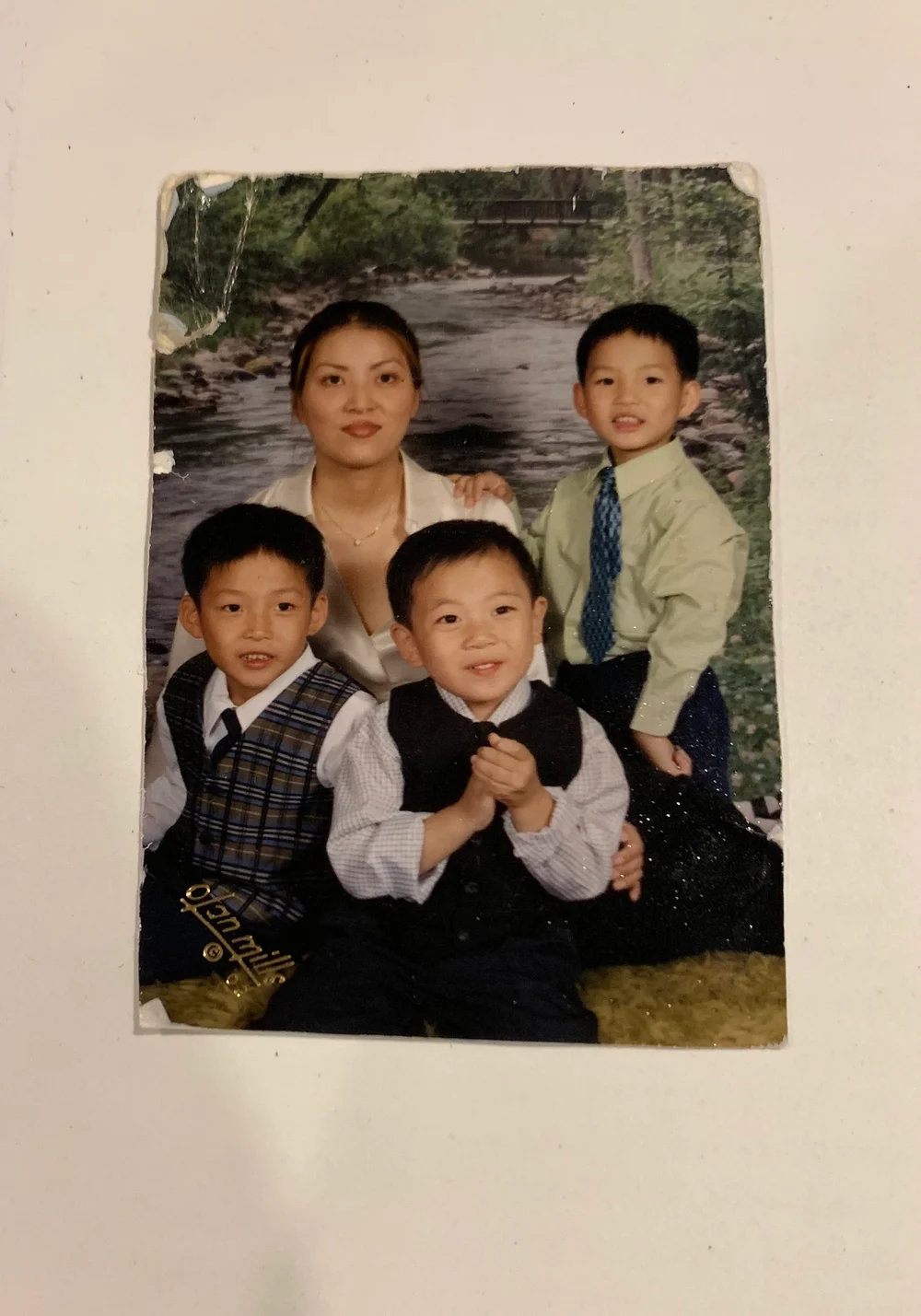
As a kid, I was thinking about the food. Looking back, I also think about the work behind those weekends. My mother was making room for something familiar and enjoyable while taking care of the practical things our family needed.
That’s the part of Chinatown I want visitors to see alongside the restaurants and the gate. A grocery store can be an errand to one person and a connection to home for another. A neighborhood can hold both at once.
Why Chinatowns formed
There isn’t one story that explains every Chinatown. People came looking for work and a future. Living near others who shared a language or regional background could help with finding a job, doing business and building a support network. But these neighborhoods also grew within a country that restricted Chinese immigration and treated Chinese people as outsiders.
The Page Act of 1875 was enforced in ways that particularly excluded Chinese women. The National Park Service explains how that discrimination made family life and family formation harder for Chinese immigrants. It’s a part of the history that can disappear when Chinatown is presented only as a colorful place to eat. Read the NPS account of the Page Act.
The Chinese Exclusion Act followed in 1882. It barred Chinese laborers, with exceptions for certain categories, rather than banning every Chinese person without exception. Its restrictions also burdened Chinese people who were eligible to enter. The act was repealed in 1943, but that did not immediately mean unrestricted immigration. National-origin quotas lasted until 1965. The National Archives’ immigration overview explains those changes.
So Chinatown wasn’t simply a community choosing to separate itself. It was also a place people built for one another while facing exclusion. That distinction matters.
How Philadelphia’s Chinatown took root
The Philadelphia Chinatown Development Corporation, or PCDC, traces the neighborhood’s beginnings to Lee Fong’s laundry at 913 Race Street in 1871. Its history describes Chinese people moving east to escape anti-Chinese hostility and building a community in Philadelphia.
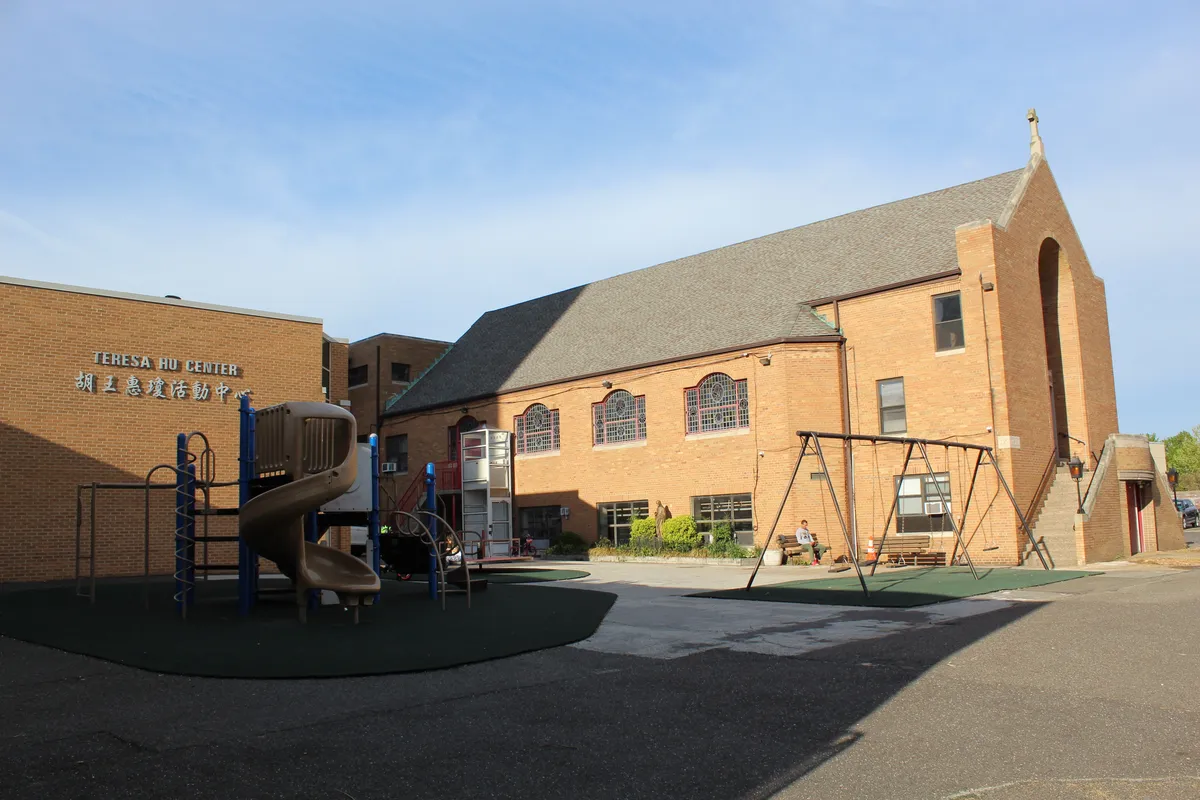

That community had to organize to remain in place. In 1966, plans for the Vine Street Expressway threatened Holy Redeemer Chinese Catholic Church and School. Cecilia Moy Yep, a widow raising three young children, was among the residents who organized. The neighborhood’s first town meeting that March led toward the organization incorporated as PCDC in 1969.
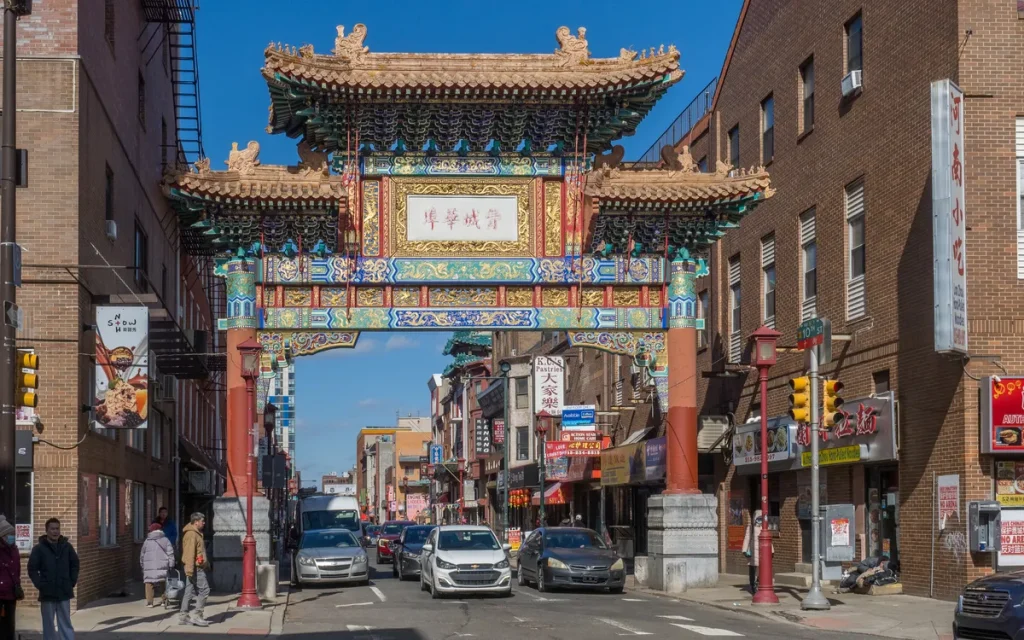
The Friendship Gate came later. Created with help from Philadelphia’s sister city, Tianjin, it was dedicated in January 1984. It is a visible landmark, but the organizing that helped sustain the neighborhood is just as much a part of the story. PCDC’s history timeline is a useful place to keep reading.
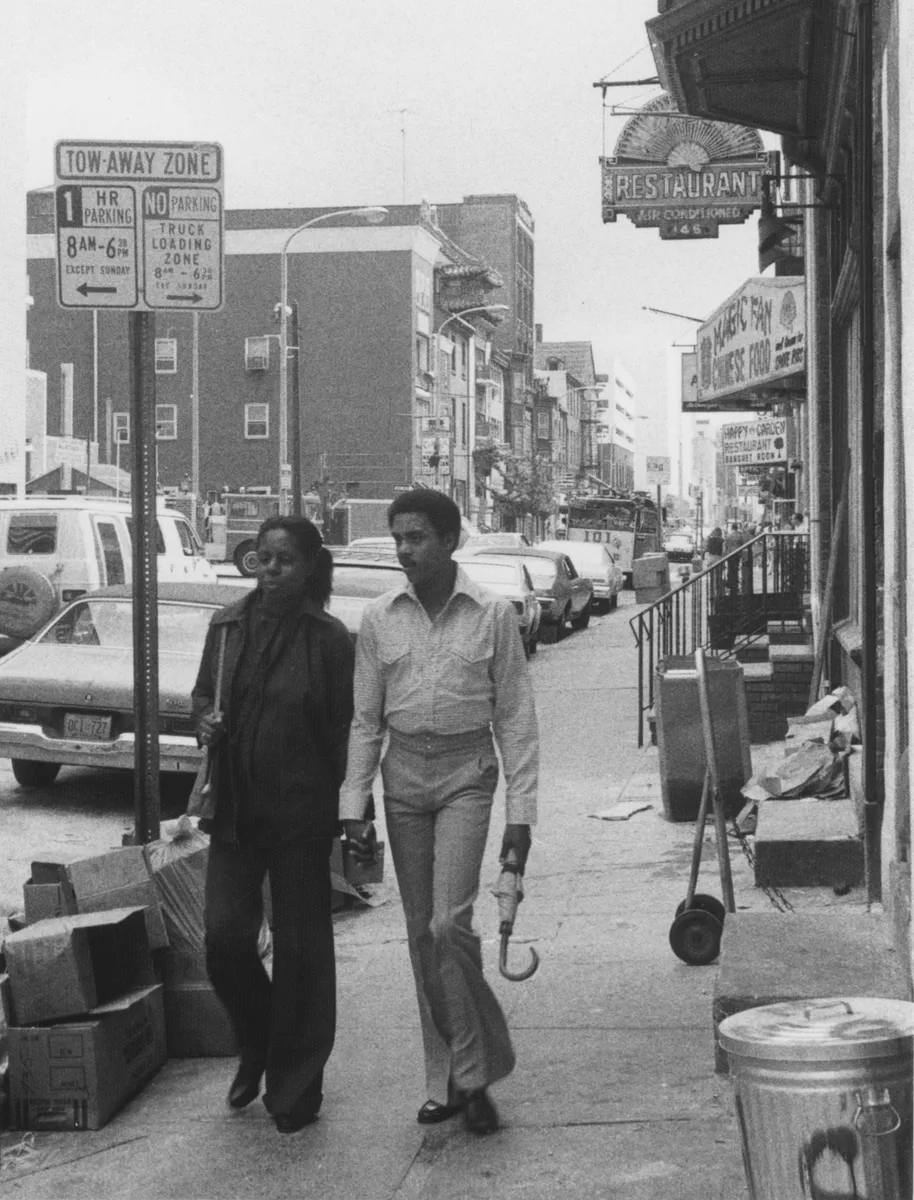
An everyday view of Race Street in 1978
A photograph of people walking along Race Street gives us another way to look at that history. This was a neighborhood people moved through in the course of an ordinary day, not just somewhere to visit for a landmark.

The 76 Place arena fight, 2022–2025
Between 2022 and 2025, residents and their allies organized against 76 Place, a proposed Sixers basketball arena at Market East, just south of Chinatown. Opponents worried about displacement, rising costs and what a large arena could mean for the neighborhood’s everyday life.
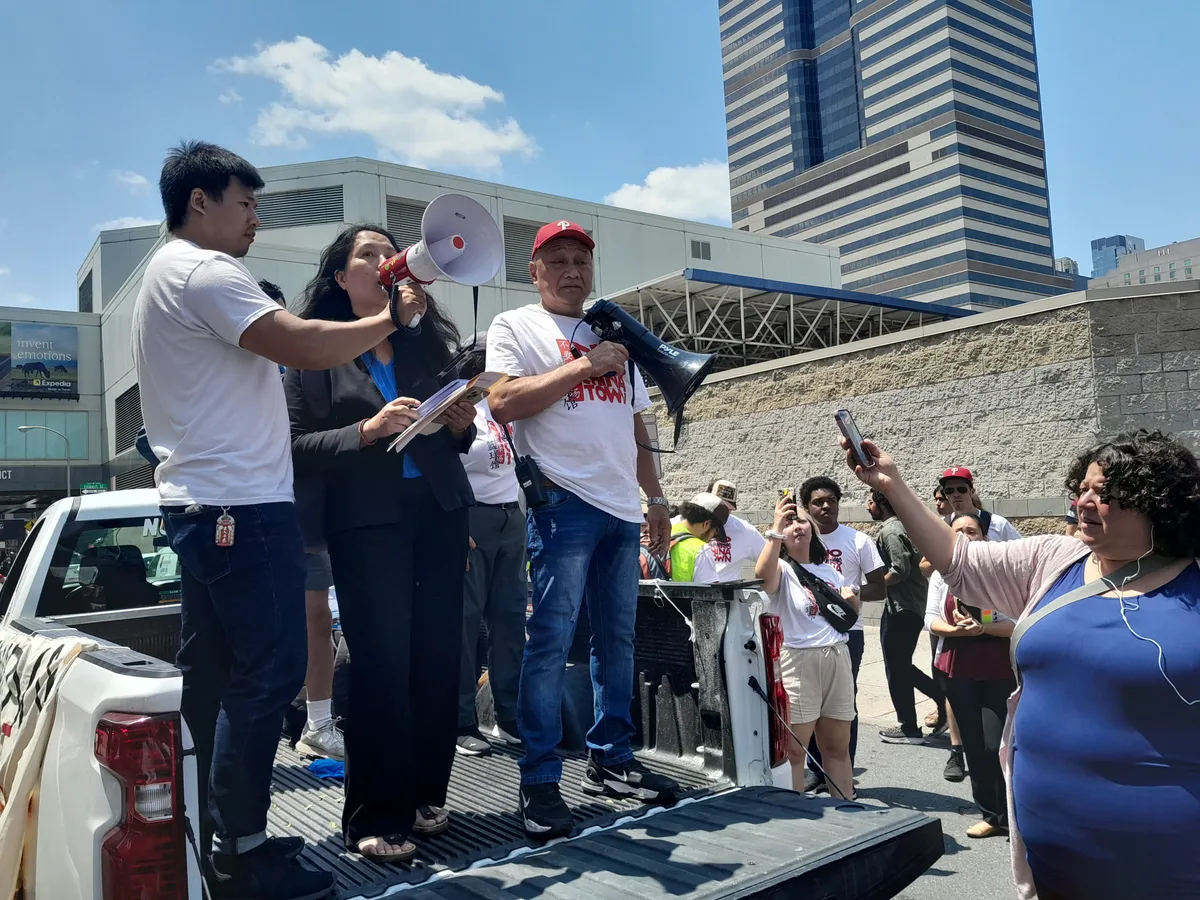

The Save Chinatown Coalition and other opponents held rallies, marched and spoke out over more than two years. On September 7, 2024, a coalition rally at City Hall was followed by a march past the proposed site. FOX 29 documented that demonstration.
- September 7, 2024
- Opponents rallied at City Hall and marched past the proposed arena site.
- December 19, 2024
- City Council approved the Center City arena plan despite the opposition.
- January 13, 2025
- The team and Comcast Spectacor announced a partnership for a new arena in South Philadelphia instead.
The reversal was not a City Council rejection. Council had approved the plan only weeks earlier, as the Associated Press reported. The owners’ January 13 announcement set out a joint venture to build in the South Philadelphia Sports Complex.
That announcement ended the 76 Place proposal at Market East. AALDEF celebrated the cancellation as a victory for the community, recognizing Asian Americans United and the Save Chinatown Coalition’s organizing.
That was the outcome neighbors had fought for. It’s worth celebrating without saying protests alone caused the decision. The campaign kept the community’s concerns in public view; the final reversal also involved the team’s new business agreement with Comcast Spectacor.
The foods that made it feel familiar
My family’s Fuzhounese and Hong Kong background meant that “Chinese food” was never just one thing to us. Some of the foods I remember were a quick snack. Others were something to sit down for. They reminded my family of where they came from, and they became familiar to me through those visits.
A bakery stop: pork floss buns and bolo bao
When we were on the go, we’d often stop at a bakery for a pork floss bun or a pineapple bun. The pineapple bun, or bolo bao, is still one of my favorites.
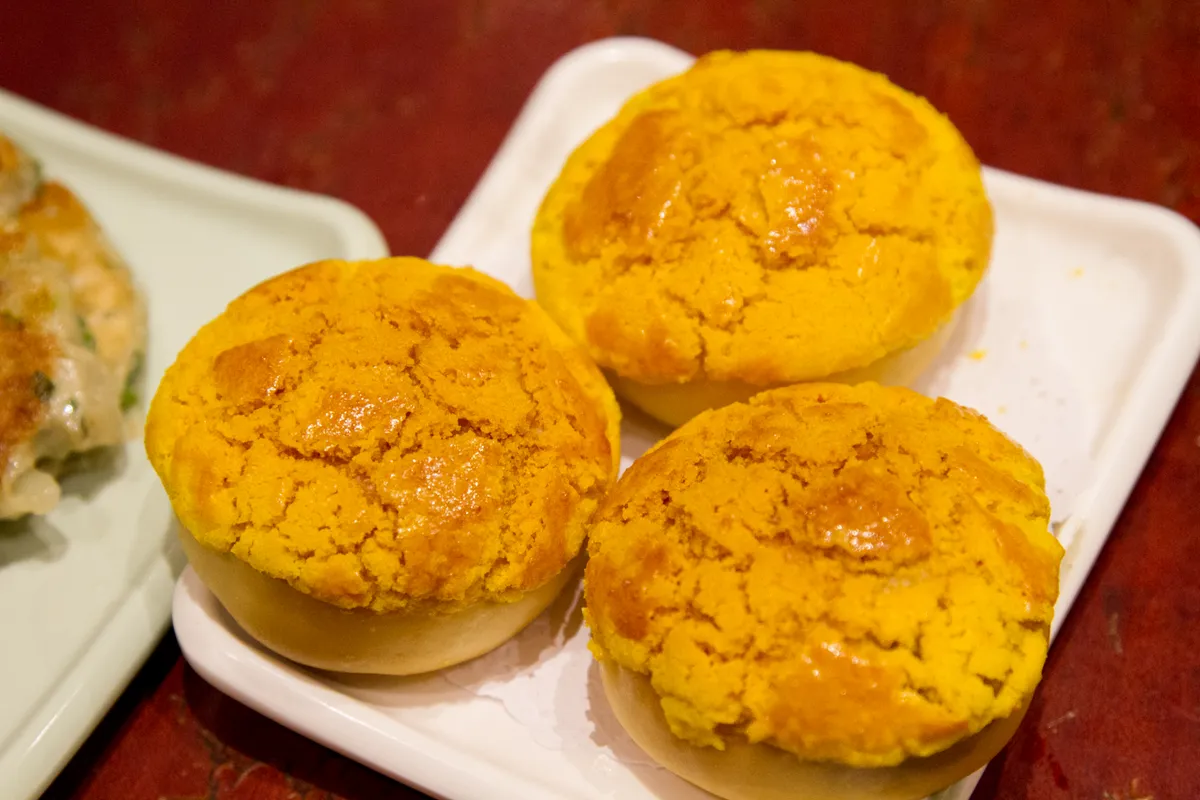

Despite the name, the traditional pineapple bun doesn’t contain pineapple. The name comes from the look of its crackled topping. Hong Kong’s Intangible Cultural Heritage Office describes that pineapple-like crust. You may find newer variations with different fillings, so the name isn’t a substitute for checking what’s in the bun.
Fishball soup, noodles and very soft tofu
Fuzhou fishball soup is another food I associate with my family. Fuzhou-style fishballs often have a fish-paste outer layer and a savory filling, rather than being a solid ball all the way through. A Fujian food feature describes the preparation. Recipes vary, and the word “fishball” alone doesn’t tell you every ingredient.
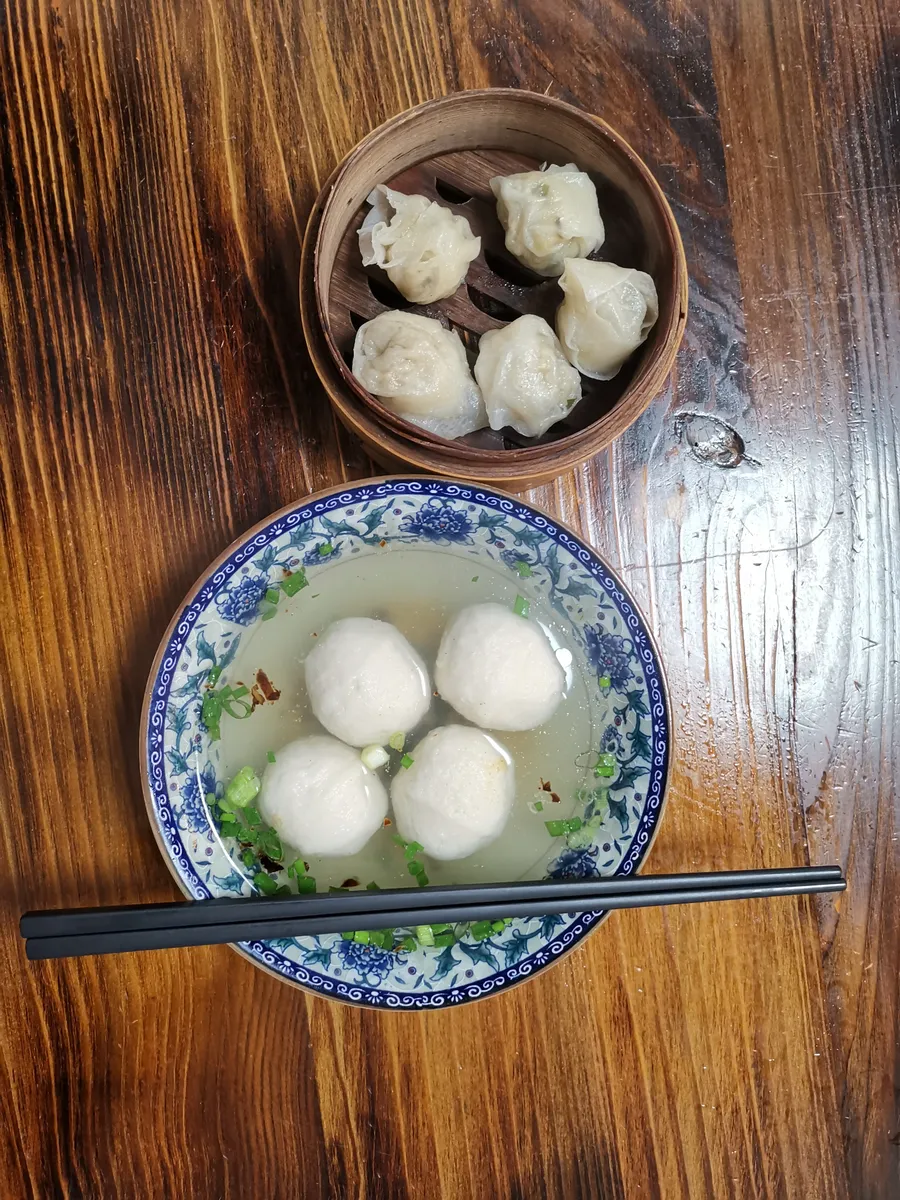

I also remember noodles with peanut and soy sauce, and the very soft tofu you eat with a spoon. Sometimes the tofu came with sweet syrup. Other times it had savory toppings. I usually preferred the savory version, though I liked the sweet one every now and then.
You may see that spoonable tofu described as tofu pudding, douhua or dou fu fa. Names and toppings differ across regions and menus. If you’re ordering it for the first time, asking whether it’s sweet or savory is more helpful than assuming every version will taste the same.
These are family memories, not a checklist of everything Chinatown offers. If you have an allergy, ask the business about ingredients and preparation. A familiar dish name doesn’t guarantee a particular recipe.
Remembering Imperial Inn
Imperial Inn is one of the places I remember from growing up around Philadelphia’s Chinatown. Its Cantonese food and dim sum were part of the neighborhood for nearly half a century.
Four men from Hong Kong founded the restaurant in 1973. It later moved to 146 North 10th Street, with a dining room and an upstairs banquet space. It closed on January 27, 2019, after more than 45 years. Michael Klein’s account of its history and the Inquirer’s report from its final day help preserve that story.
A place can feel permanent when you know it from childhood. Its closing is a reminder that the businesses tied to our memories are also workplaces, built and kept going by people who eventually need to retire. Not every closing has the same cause.
Around a dim sum table
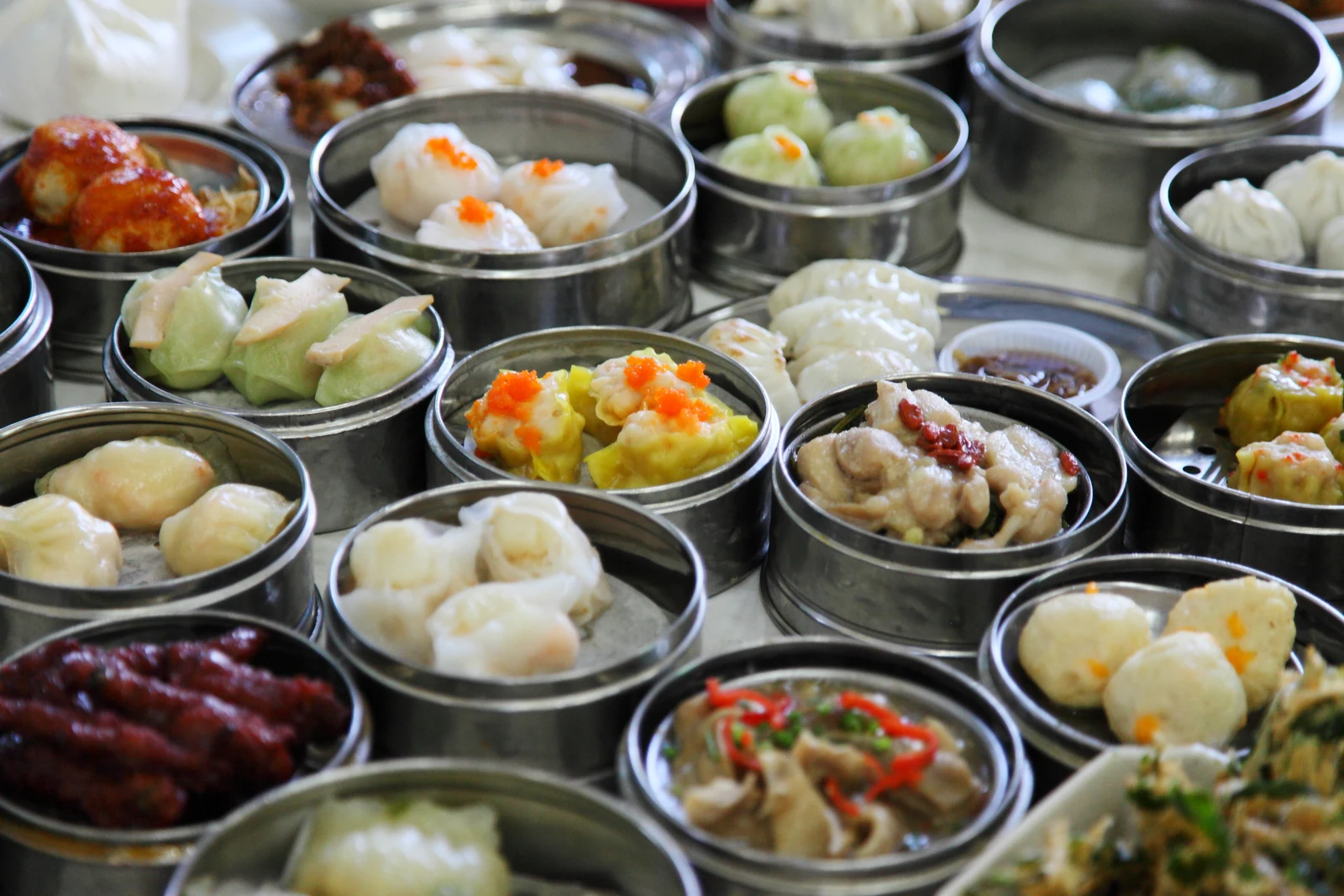
A spread of small dishes makes the variety easier to see than a single close-up. LeonardKong’s photograph below shows dumplings and other dim sum in metal steamers. It’s a reference for the food tradition, not a photograph of Imperial Inn. Its location hasn’t been verified as Philadelphia.

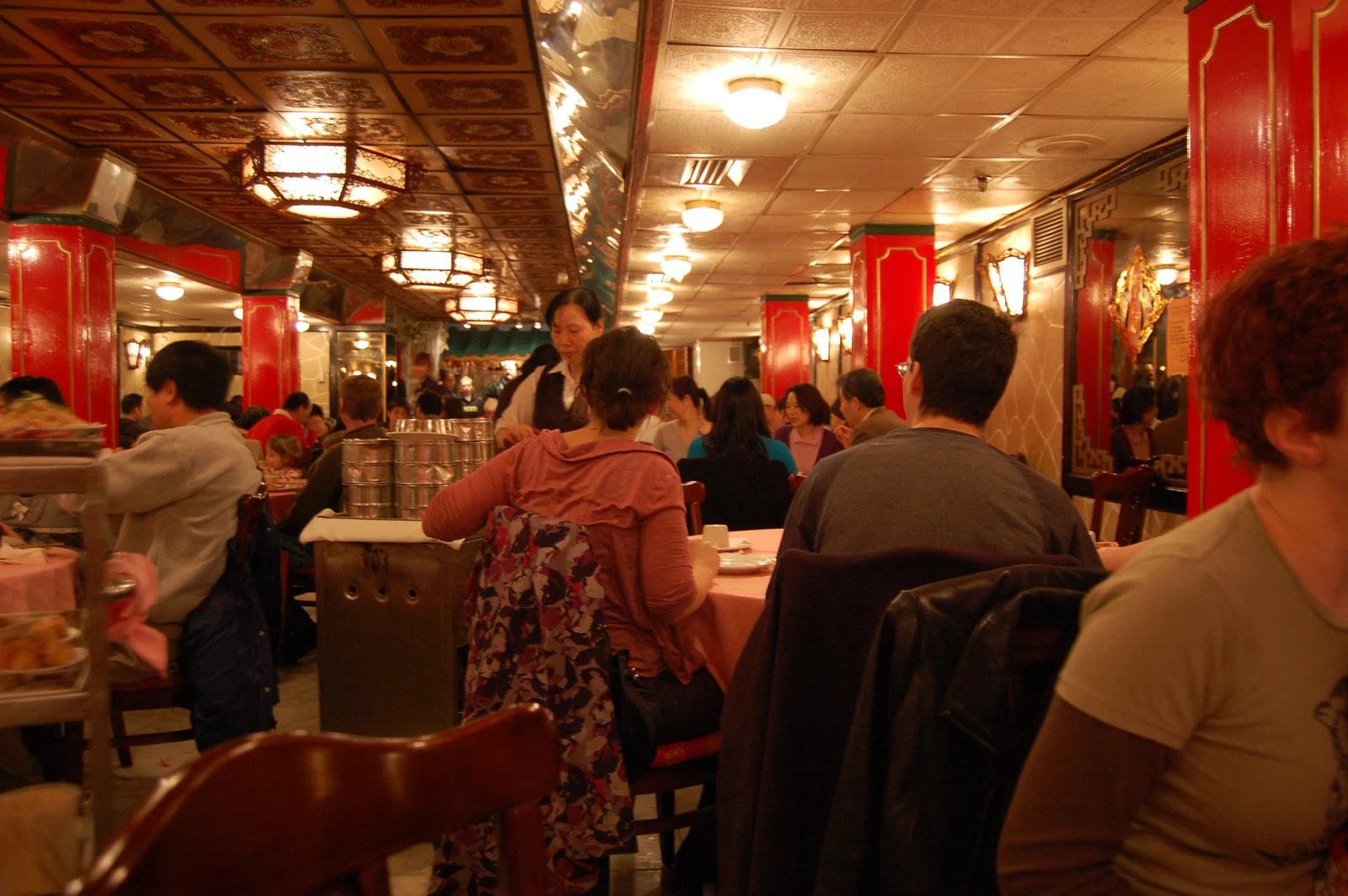
The room is part of the experience
Sam Blackman photographed this busy dining room during a Philadelphia Chinatown meetup in March 2010. The tables and serving carts give a sense of the meal around the food. The photographer identifies the neighborhood, but not the restaurant, so I’m not presenting it as Imperial Inn or as one of my family’s visits.
Preserving a neighborhood, not just a destination
Preserving Chinatown means more than keeping its most recognizable buildings. Linda Coutant’s 2024 NPCA essay on preserving Chinatowns, which prompted me to write this story, connects these neighborhoods to a longer history of discrimination and displacement. That history gives visitors a reason to look beyond the landmarks and consider the people who live and work here.
To me, keeping a recognizable gate while losing the everyday life around it would not be enough. The groceries matter. So do the homes, schools and places where people can ask for help.
PCDC describes its work as supporting Chinatown as a residential, business and cultural community. Its community mission and services are a reminder that this neighborhood is more than its restaurant reputation.
As someone who works in real estate, I don’t want to frame a living community as a place to “discover” before everyone else does. Learning about a neighborhood should include listening to people already there.
A thoughtful way to visit Philadelphia’s Chinatown
You don’t need a packed itinerary. Start with PCDC’s Chinatown visitor guide, then choose a few stops that interest you. Check each business’s own hours and menu before making a special trip. The foods I’ve described are family memories, not a list of shops with confirmed availability. Imperial Inn is included for its history; it closed in 2019 and isn’t a stop you can visit for a meal.
Buy something from a local business if you can. Leave room on the sidewalk and at shop entrances. Ask before photographing people or the inside of a business. It’s possible to enjoy a neighborhood without treating everyone in it as part of the scenery.
For my family, Chinatown wasn’t a project or an attraction we needed to finish. It was somewhere we returned to. A bun from the bakery, groceries for later and time with my mother were enough to make the trip matter.
I’d like more people to understand that side of it.
About this story and its sources
Family memories were supplied by Frankie Tang. Historical context comes from PCDC, the National Archives and the National Park Service. The arena section separates the community campaign from the owners’ January 2025 business agreement, with links to reporting and statements from the parties involved. Imperial Inn’s dates come from contemporary Inquirer reporting. Its closure in 2019 preceded the 2022 arena proposal; this article does not attribute the restaurant’s closing to that campaign. The NPCA essay was published in May 2024 and is used for historical preservation context, not as a current development-project update. Food references describe traditions, not verified menus. Research checked October 20, 2026. Photo dates and licenses are listed separately below.
Sources & method
Information in this guide was checked October 20, 2026. Source links appear in the text above. Dates, prices and hours can change, so confirm with the official source before you rely on them.
Photo credits and image details
These photographs were resized and converted to WebP for this website, with no crop or content changes. Source and license links are below. Dates describe the source photos, not current conditions or future events.
- ajay_suresh · CC BY 2.0Philadelphia’s Friendship Gate at 10th and Arch Streets, February 2024.
- Family photograph supplied by Frankie Tang; Olan Mills studio mark retained. Family archive; no reuse license grantedA childhood family portrait supplied by Frankie Tang, who is at the lower left. This studio portrait was not taken in Chinatown. Date not supplied. Full frame and studio mark retained; no AI reconstruction.
- Eric Schucht · CC0Holy Redeemer Chinese Catholic Church and School, August 2018. This is the community institution discussed below, not a photograph of the 1960s protests.
- © Acabashi · CC BY-SA 4.0People walking along Race Street in Philadelphia’s Chinatown, 1978. The supplied scan was previously optimized by its photographer.
- 7beachbum · CC BY 2.0Opponents of the proposed Sixers arena demonstrating in June 2023. This is not the September 2024 rally or the January 2025 announcement.
- Party Lin · CC BY 2.0Pineapple buns, photographed in 2012. A food reference, not a Philadelphia bakery recommendation or a family photograph.
- Lennartbj · CC BY-SA 4.0Fuzhou fishballs, photographed in 2019. A food reference, not a meal documented at a Philadelphia restaurant.
- LeonardKong · CC BY 2.0Dim sum in small steamers, photographed in March 2013. A food-tradition reference; the location is not verified as Philadelphia. Not Imperial Inn or a family meal.
- Sam Blackman · CC BY 2.0A Philadelphia Chinatown dim sum dining room, March 7, 2010. The photographer identifies the neighborhood, but not the restaurant. Not identified as Imperial Inn; pictured diners and staff do not endorse HwF.